
When we visited El Karama Ranch in Laikipia we expected to be shown a lot of large farm livestock and to see impressive wildlife, such as elephants. We experienced both but we were also consulted about a young white-browed sparrow-weaver (Plocepasser mahali) that had been found by Mrs Lavinia Grant (a long-term Kenya resident, renowned author and artist) who found the fledgling in a nest that had fallen, or perhaps been removed, from a tree.
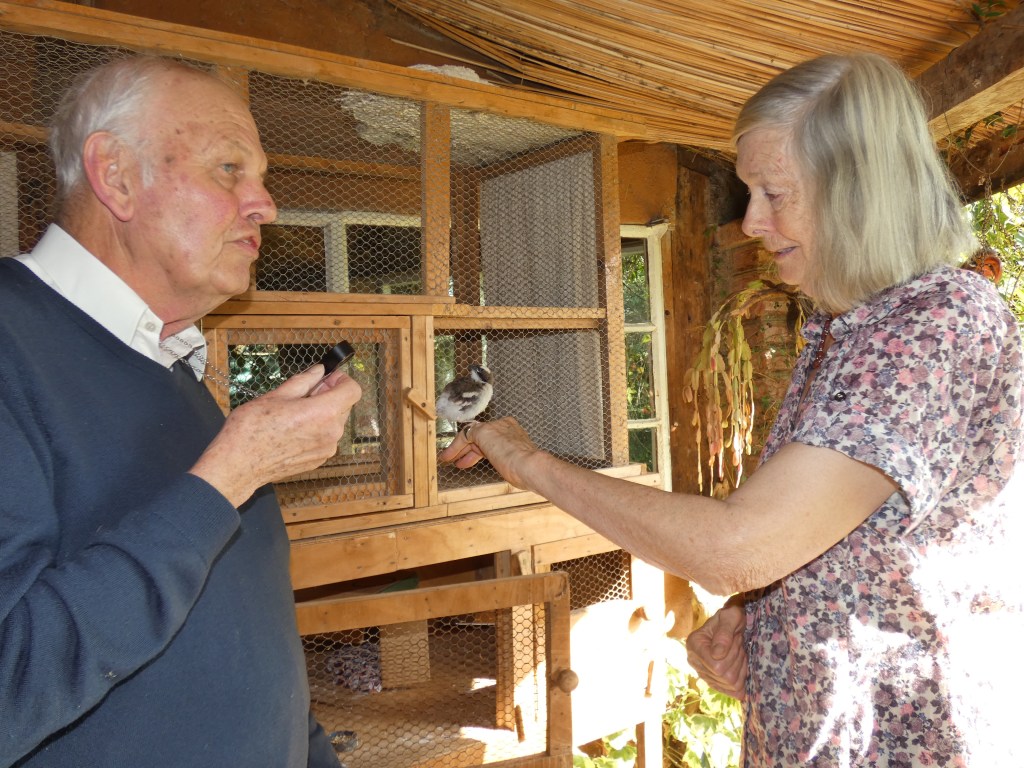
Mrs Grant had done a wonderful job of hand-rearing this youngster – a specially-constructed spacious cage on her verandah (see photo 1.), a diet that included insects and grit, and lashings of tender loving care (TLC). However, it was soon apparent that this bird had a problem – its flight (primary) and tail feathers were failing to develop and differentiate properly and instead were falling out prematurely and presenting as stunted, twisted, structures. In particular, the fledgling appeared to have no tail (see photo 2.).

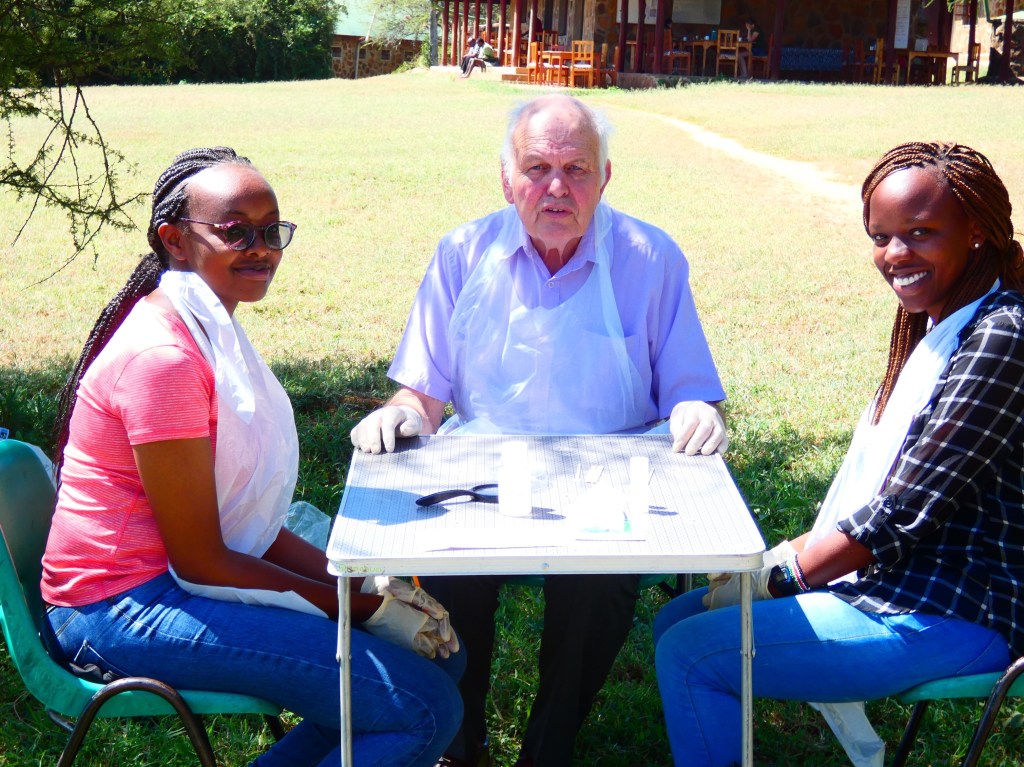
We managed to obtain some of the dropped feathers and we took them back to Mpala Research Centre (MRC) where John, Dr Maureen Kamau (veterinary surgeon at MRC) and Dr Sharon Mulindi (veterinary intern at MRC) carried out a preliminary examination under field conditions (see photo 3)
Preliminary investigations suggest that this is a developmental abnormality, a “feather follicular dystrophy”, rather than an infectious or nutritional disease, but further, more sophisticated, laboratory tests are planned. Watch this space!
This case illustrates how even in the “bush” in East Africa, one can use techniques, improvised as necessary, to investigate an animal disease – even if the patient is a small wild bird, not a cow, a dog or an elephant!
With best wishes to all
John and Margaret Cooper


2 responses to “From John and Margaret Cooper in Kenya”
Wonderful job Margaret and John E.Coopers and all the participant,it was quite interesting,snake handling and welfare! Here in Rwanda,out community are very afraid of snake and many are killed when found in community environment!!
I think more extension course are highly needed!
Good job,
LikeLiked by 1 person
Dear Dr Christophe
Asante sana!
Yes, we are aware of the (understandable) fear that many Africans have for snakes. Even here in Britain many people don’t like them But snakes, likeall
animals are part of biodiversity and they do a lot of good by killing pests, such as rats.
Kenya is fortunate in that it has a number of people (wananchi) who are interested in reptiles, including snakes. The research at the at the Kenya Snakebite
Research and Intervention Centre (KSRIC) near Nairobi will ultimately save many hundreds of lives – both human and animal.
Come and attend one of our reptile workshops in Kenya sometime! Karibu.
We hope you keep well.
Best wishes na ya kuonana
John and Margaret Cooper
LikeLiked by 1 person