
Introduction
We flew back from Kenya, East Africa, on Tuesday 18th April after a seventeen-day visit together,
Kenya is, of course, our “nyumba ya pili” (second home), in which our children were born in the 1970s and where we have spent happy years together.
We had a very good time and were able to catch up with friends, colleagues and projects after our period away on account of SARS-Cov-2 coronavirus. John had undertaken an earlier, preliminary, trip to Kenya in September 2023 with our friend Professor Charles Foster; see: https://thefrightenedfaceofnature.com/2022/10/23/visit-to-kenya-september-october-2022/
Summary
On our joint visit in April, in addition to our time in Nairobi we had eventful trips to the Coast, to the Leakeys’ farm near Nakuru, to the Ewaso Lions project in Samburu and to Mpala Research Centre (MRC) in Laikipia.
At each of these we had some exciting animal encounters – ranging from avoiding elephants in our camp to tracking wild carnivores and treating a camel that had been attacked by a lion. We were able to get some good photos and interviews for our next book, about human-animal conflict, which is due to be published by Taylor and Francis in 2024.
Specifics
For those who might be interested in more detail, we include below excerpts of messages sent back to family and friends during our trip, together with a few photos. They give some indication as to what we were seeing and doing.
Arrival in Nairobi
“We arrived in Nairobi early (05.00) this morning on an overnight flight. They have had some rain, which is welcome and hopefully augurs well for the drought-ridden parts of the country.
We had our breakfast on the UKC balcony recovering from the overnight flight. A marabou stork and sacred ibises on the UKC lawn, black kites circling overhead and the sound of sunbirds and a probable “rain bird” in the trees.
A nice surprise when we entered our room at the United Kenya Club (UKC). A message of welcome from the new General Manager, plus a vase of flowers and two plates of fresh fruit.
We are here at the UKC in Nairobi until early Sunday when we leave by train for Mombasa for four days”.
Mombasa
“Here in Mombasa, we have only limited, periodical access to the internet. We are receiving and sending short emails (without attachments or, alas, photos taken on our cameras) but websites are proving impossible.
Yesterday morning we travelled by tuk-tuk to the Mission for Seafarers here in Mombasa and resumed our programme of health monitoring of their tortoises. JEC examined one clinical case and we initiated a study on shell lesions – their prevalence, pathogenesis and possible treatment. We said a final, sad, farewell to Shamba Musa, our much-loved piece of African bush near Kwale (Figure 1). As part of that farewell, we entertained our former members of staff to a meal of “nyama choma” – cooked goat or beef with ugali and vegetables – at a local bar/restaurant. Organising and implementing this was not easy as we are in the middle of the Holy Month of Ramadhan (“Ramadani” in Swahili) and three of our former staff are Muslims. The rest of us were Christians or of mixed religious background (very few East Africans do not believe in God). We solved the dilemma by the three Muslims taking home their food and a soda apiece to eat at Iftar when they broke their fast. We started the meal with an interfaith prayer in Swahili, thanking God that we were together again and expressing gratitude for the food and our health. At the end, Margaret presented everyone with gifts, including some (very popular) coloured caps! It all seemed to go well”.
Figure 1

Visiting the Leakeys
“Greetings for Easter. We are “up-country” near Nakuru, at Rajwera arm, staying on the Leakeys’ farm in the Rift Valley and checking our teaching equipment.
We are sleeping in a large safari tent with all “mod cons”, a short distance from the new main house that is still being completed.
Weaver bird nests in the acacia tree outside the tent. Boran cattle walk by. Geese graze a few metres away. Guineafowl cackle as they pass by. Reed frogs call as the rain falls – and African toads croak as night falls. Dogs, including the famous Leakey Dalmatians, litter the verandah.
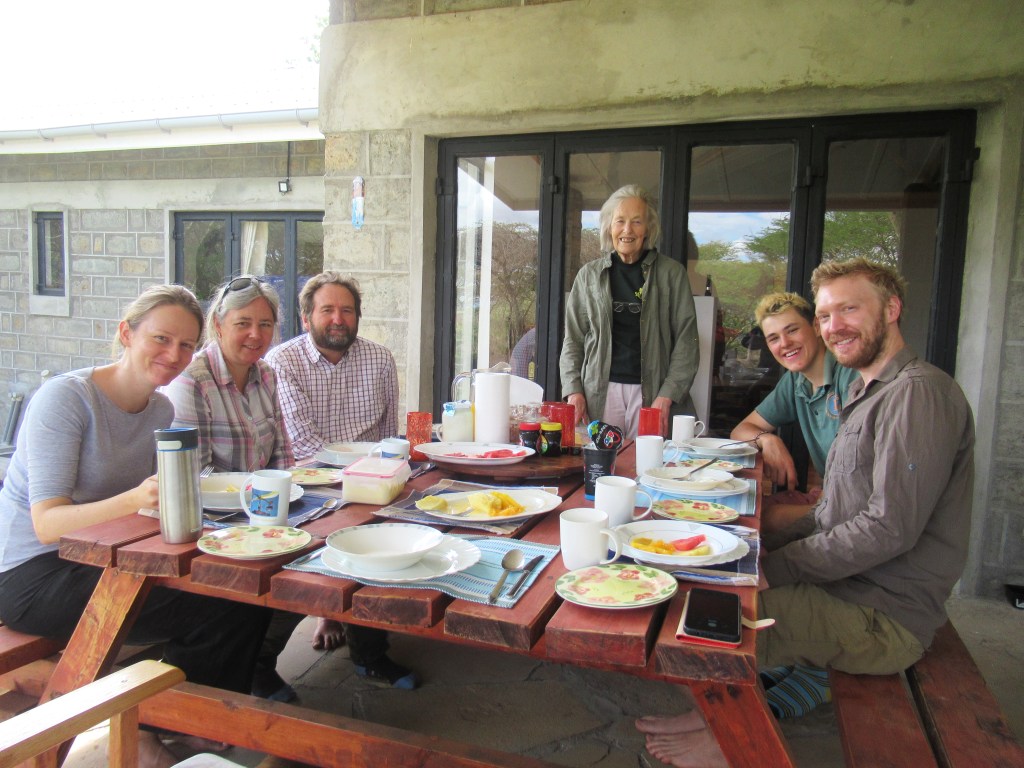
A very warm welcome from Janey and Nigel Leakey (John’s godson) (Figure 2) and their staff, including Philip the cook, a super chap, who has known us for some years”.
Figure 2
“The Leakeys send their regards. John was knocked down by one of their Boran bulls. No bones broken, a bit of bruising. See photo below”. (Figure 3)
Figure 3
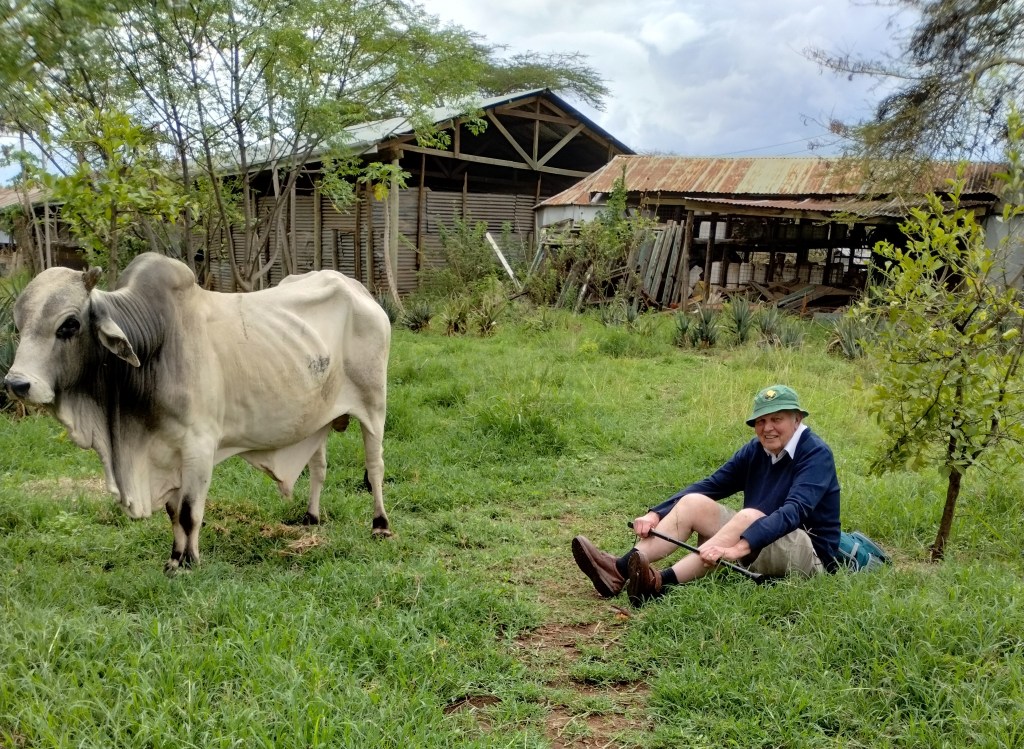
Perhaps the bull knew that we are writing a book about human-animal conflict!
We now travel to Samburu to see animal health projects with our young veterinary colleague Dr Jessicah Kurere and to Mpala Research Centre (MRC), Laikipia, to discuss training workshops
We have a hectic few days coming up”.
Samburu
“We are in an idyllic spot in the bush in Samburu in Northern Kenya, guests of our young veterinary colleague, friend and former student Dr Jessicah Kurere and the Ewaso Lions Project. We have only limited internet access but this is countered by the presence of so much wildlife in the vicinity of the camp, including elephants and lions and many species of bird and insect.
We went through Samburu National Reserve on very rough roads.
We spent this morning with our host at Ewaso Lions in some Samburu manyattas while she treated camels (Figures 4, 5 and 6) and helped with orphaned kittens and puppies and anything else. A lot of the children still do not go the school but help with the livestock. The girls still milk the camels into traditional gourds.
Yet they have small solar panels for lighting”.
Figure 4
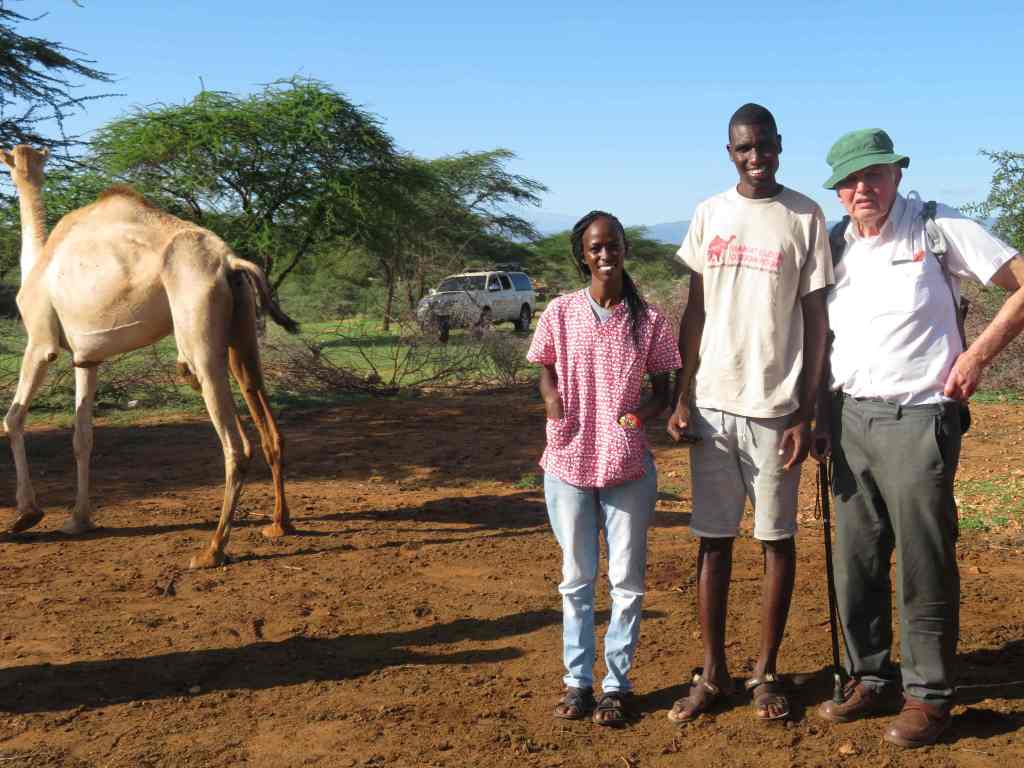
Figure 5
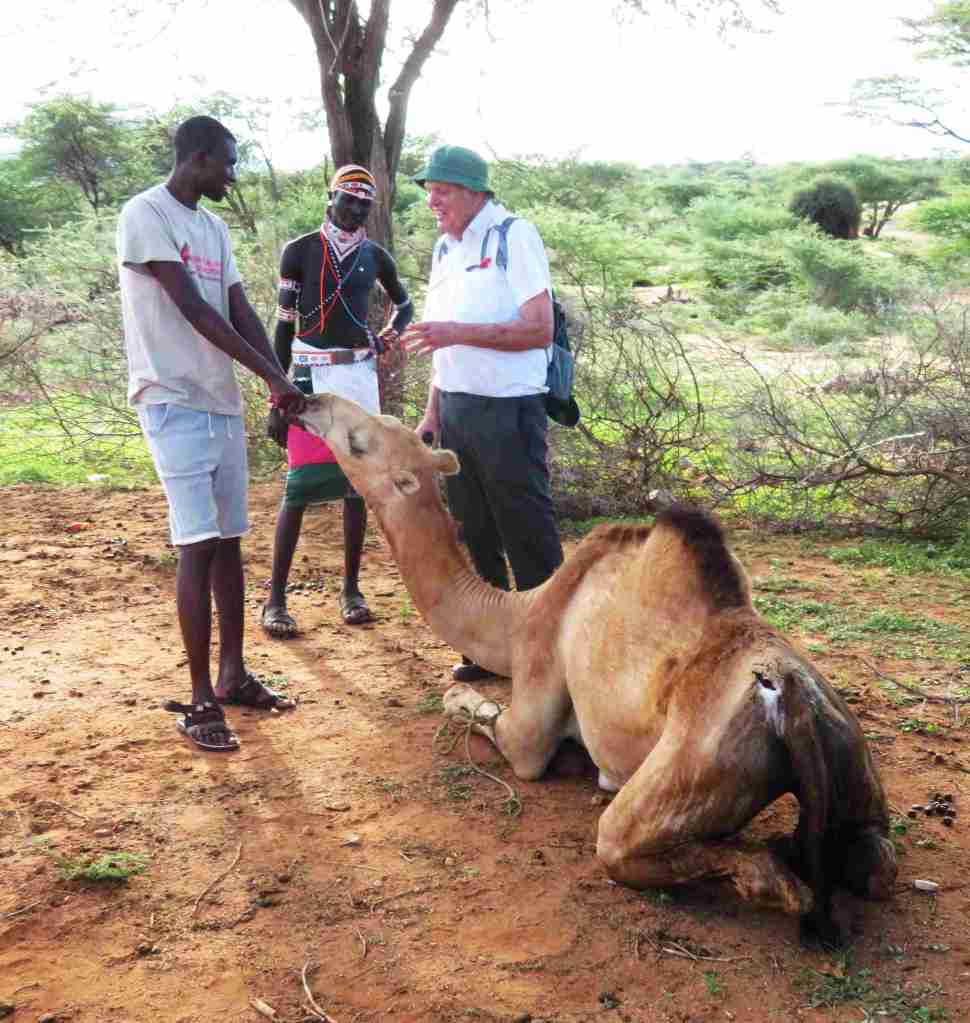
Figure 6

“We are going on a game drive tomorrow very early in the morning. Up with the sun literally.
Very hot, we are drinking a lot of water”. (Figure 7)
Figure 7
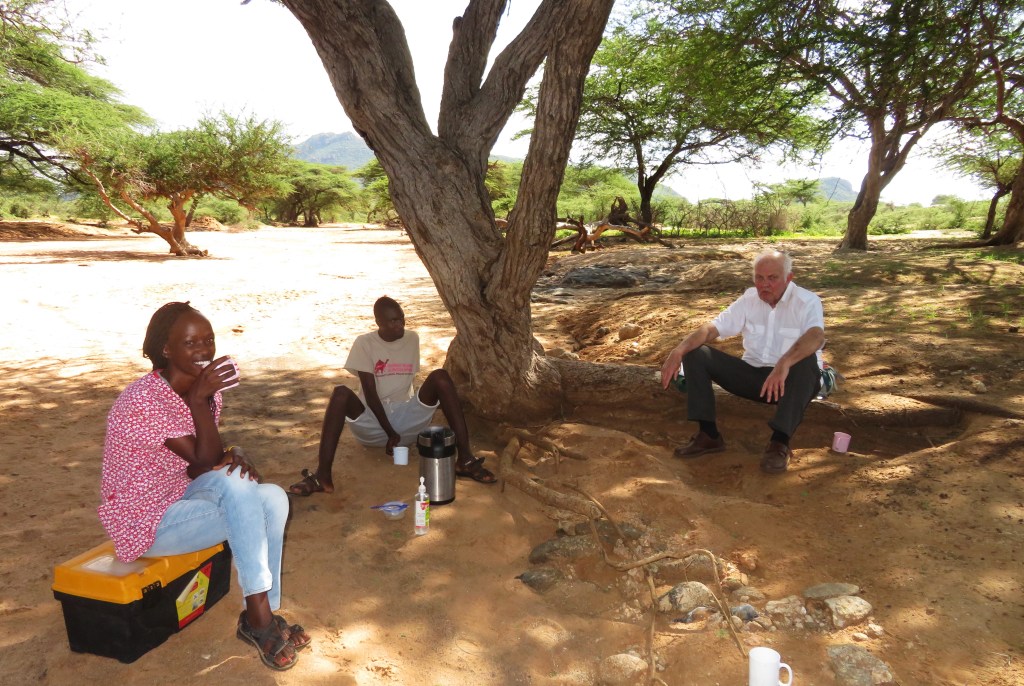
Figure 8
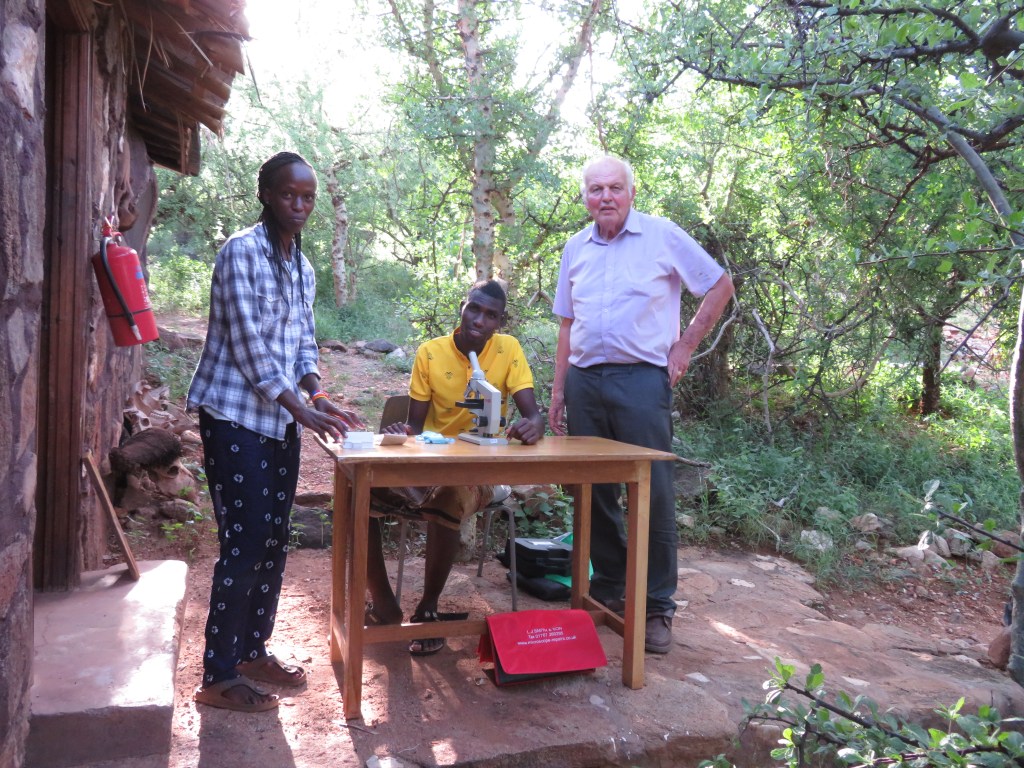
Figure 9
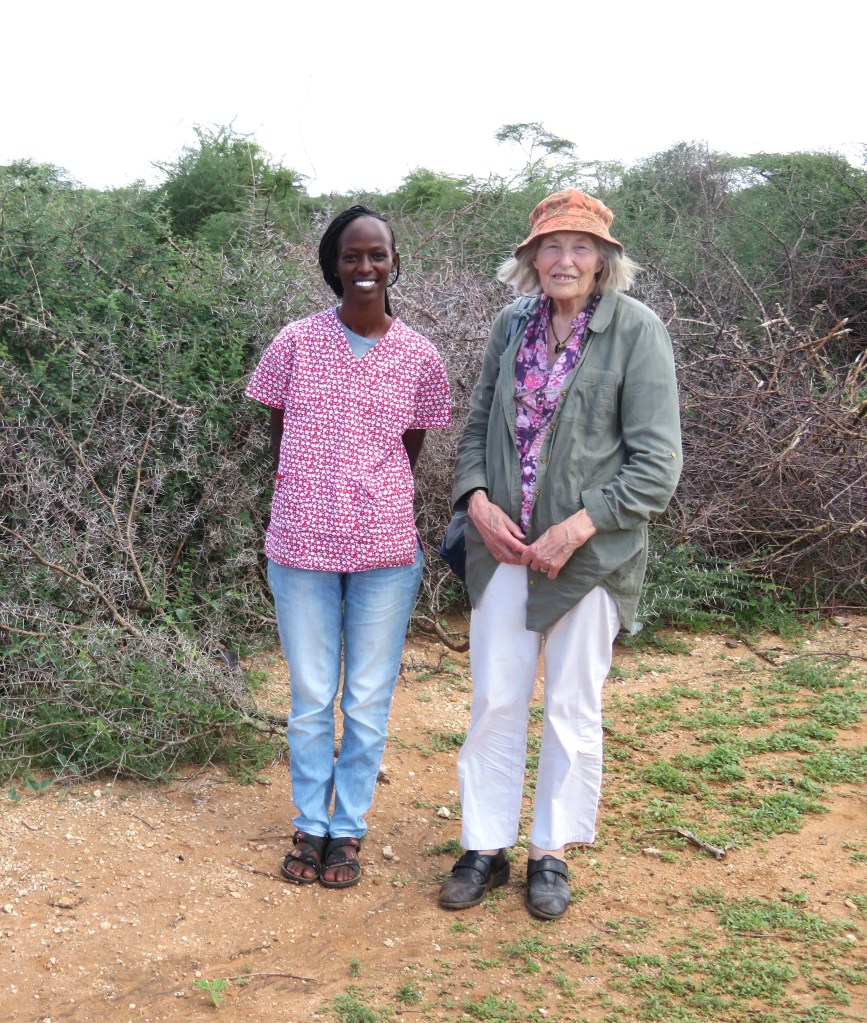
Mpala Research Centre
“We then went on to Mpala Research Centre (MRC), Laikipia. In contrast to Samburu, where rain has fallen and vegetation is looking green, Laikipia is still in the grip of the drought. Everything is dry and dusty – but it was still a delight to be there, to meet old friends and to experience the terrain and the animals.
They seem keen that we should organise and co-ordinate a training workshop about sampling techniques, both in the field and in the laboratory, later this year or early next”.
Back in Nairobi
“Our apologies that we have again had only limited internet access but we are now back in Nairobi at the United Kenya Club (UKC).
We are safely back at the UKC after our exciting trip to the Leakeys’ farm, the Ewaso Lions project in Samburu and Mpala Research Centre (MRC), Laikipia. On our way back to Nairobi we stopped for a light lunch at the delightful Naro Moru Lodge where we stayed as a family (four of us, two tiny children) 50 years ago when John and colleagues climbed Lenana peak on Mount Kenya.
Everyone is happy here in Nairobi because it is raining every day – a much needed opportunity to till the ground and to plant crops. We Brits learned long ago that rain is a blessing in Africa even though we often curse it in England.
We had a busy day yesterday (what’s new?). A visit to the Institute of Primate Research (IPR) to return equipment, then to the Vet Lab, Kabete, to collect Dad’s 2023 veterinary registration documents and to pay KVB and KVA fees. We pointed out to the IPR driver “our” house on the Kabete campus to which our two children returned from Nairobi Hospital five decades ago.
Wonderful welcomes from people in different offices.
In the afternoon, we went to the Snake Park to see our friend Margaret Njeri, the new Senior Curator, and discussed a possible reptile workshop later in the year/early 2024. We then had a long, but interesting, session with a young Kenyan who wanted advice about his career in forensic entomology. Interestingly, hardly anyone out here asks us whether we are “retired”, probably because most Africans continue work on their shamba at home when they finish a standard job – or, especially in the case of the ladies, start a small business enterprise. Most of our colleagues and students assume that we, “The Coopers”, will go on forever – despite being “wazee”. We shall miss the good-hearted banter and joking here when we get back to the politically-sensitive UK next week.
We were kept busy when we got back to Nairobi last week. On Friday morning we were at the KIPRE, formerly IPR, including doing a training session in the snakebite unit with Geofrey Kephah and Dr Jacob Lubuya. We went on to the Vet Lab, Kabete, to collect John’s veterinary registration documents and to pay his KVB and KVA fees.
In the afternoon we visited the Nairobi Snake Park to see Mrs Margaret Njeri and her staff. Mrs Njeri is keen that we help her organise a reptile workshop later this year/early 2024.
Best of all is a leisurely lunch with Paul Sayer on Saturday – and we hope to look at his tortoises”. (Figure 10)
(Figure 10)
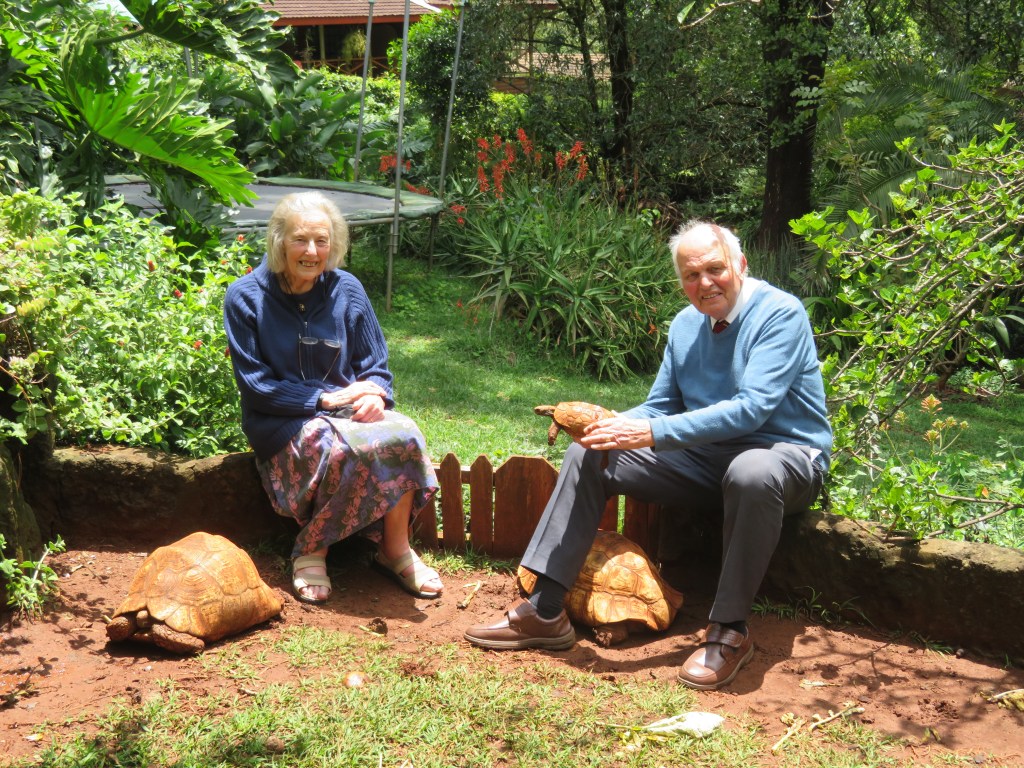
“The lunch that we hosted at the United Kenya Club (UKC) on Sunday went well. We were fifteen in number and there was a nice mixture of ages and backgrounds. We were very pleased that Jacinta Chege and Howard Atubwa from the Reptile Research Group (RRG) were able to join us (Figure 11); Margaret (Cooper) told them about the tortoise/terrapin shell study at the Coast and gave them a cloth bag from the UK containing record sheets, two boxes of chalks and a plastic ruler. She challenged them to develop an appropriate project for the Snake Charmers!
We fly back to Britain (sadly) on Monday”.
Figure 11

The flight home
“Throughout our trip in Kenya, we were mindful that we have a contract from Taylor and Francis to write a book with Charles Foster and his wife about the science and law of human animal conflict. Our various visits – especially coming to see you in Samburu – provided numerous examples of such interactions. Even on our last day, when we were meant just to be flying home, there were two examples. See below.
We thought our Kenya adventure had finished when we (sadly) left the United Kenya Club for our flight at 05.30 on Monday morning but that was not to be! First, the X-ray machine in the security hall at Nairobi Airport (JKIA) detected in one of our suitcases the model snake that we use for teaching. The security man wanted the suitcase to be opened but this had to be done discreetly since, as you know, most East Africans are frightened of snakes. There was much mirth when the snake proved to be a model. It was then passed around from one official to another before being returned to us for the homeward journey.
The second human-animal conflict incident was more serious. We were told that a cargo plane had blocked the main runway at JKIA and no large aircraft could take off. This was the result of a bird strike due to the main runway being blocked for much of the day, with ensuing disarray.
As a result of the runway blockage, our flight was repeatedly delayed. Pending removal of the cargo plane, we and the other Kenya Airways passengers spent hours being moved around JKIA and then in and out of the Panari Hotel. The latter was very posh, a welcome retreat, but not really our cup of tea – we felt like tourists. However, being herded together with the other Kenya Airways passengers meant that we made many new friends – and there was much good-hearted banter.
We managed to get to the front of the queue in the channel marked “Diplomats” by joining forces with a delightful elderly Tanzanian called Mzee Diaz (Figure 12). We called over an airport official and pointed out that John had a stick and an arthritic left knee and our companion was also too elderly to stand in line for a prolonged period. The conversation was all in Swahili (in Mzee Diaz’s case, in beautiful “Ki-Swahili cha Tanzania”) and it did the trick. We three (two wazee plus Margaret) were quickly shown to the front of an immigration channel and were soon on our way upstairs to the departure lounge”.
Figure 12.
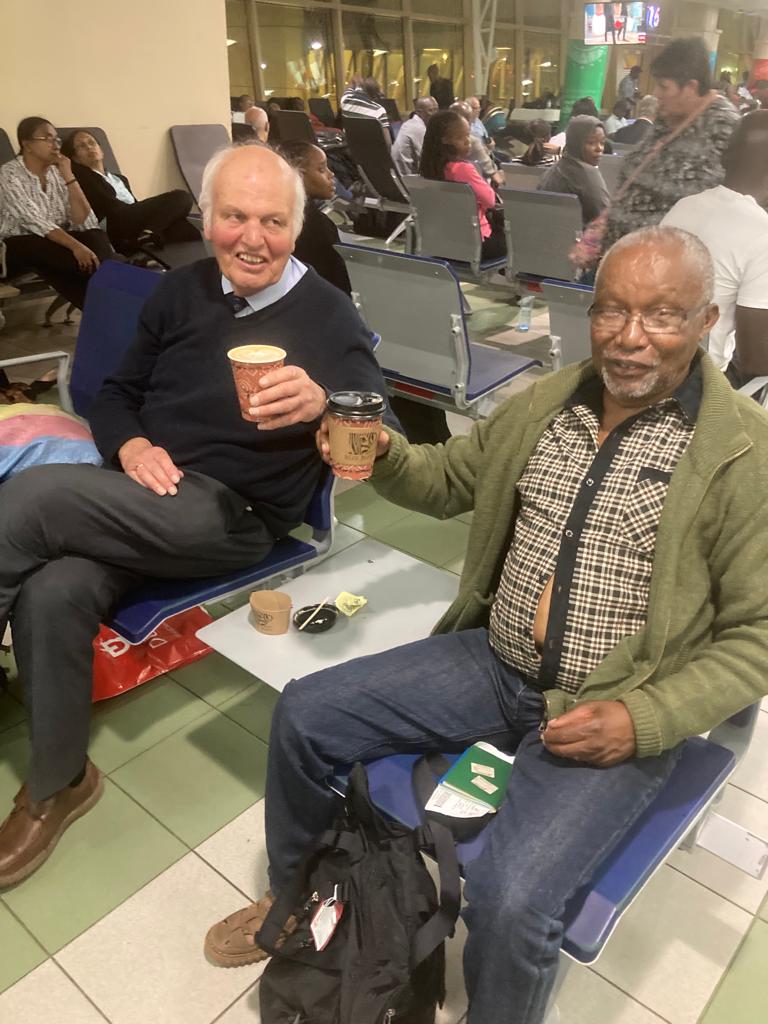
We boarded the plane for the second and final time late on Monday evening and finally took off at 02.00”.
Back in Britain
“We arrived at London Heathrow Airport (LHR) at about 08.30 British Summer Time (BST) on Tuesday. The taxi that we had booked to bring us home in comfort, direct from LHR, cancelled just as we were about to take off. So, in the end, we decided to cut our losses and take the London Underground and main train home, as we always have in the past. We were relieved to discover that, in the middle of the day, this was not too difficult – even with four suitcases and two rucksacks. We also learned that we are more resilient than we thought at this age – and we were spared an expensive taxi fare!
We returned to Britain to a mound of correspondence and commitments, including lectures in Cambridge and London, on-line teaching and articles for journals and websites. Margaret has another cataract operation next week and the NHS (National Health Service) will probably do John’s arthritic knee replacement in June or July. On top of all this, we have to sell a house, downsize another, and plan to move nearer to our family in Sussex”.
And we concluded
“It was a super trip.
Back here in Norfolk, England, buds are opening, the trees are beginning to look green again and some are bearing blossom, small flowers are appearing on the roadside, a few insects are venturing out when the sun shines and birds are busily nesting. Soon migrant species, such as swallows, will arrive from the south and, like us, spend the summer enjoying England’s “green and pleasant land” before flying back to Africa. We envy them, but shall return to Kenya ourselves in due course”.
John and Margaret Cooper
JOHN E COOPER, DTVM, FRCPath, FRSB, Hon FFFLM, FRCVS
RCVS Specialist in Veterinary Pathology
Diplomate, European College of Veterinary Pathologists
Diplomate, European College of Zoological Medicine
MARGARET E COOPER, LLB, FLS, Hon FFFLM, Hon FRCPath
Solicitor (not in private practice)
Wildlife Health, Forensic and Comparative Pathology Services (UK)
Photos: John & Margaret (mainly Margaret!) Cooper.
Comment from Simon King (just about to upload John and Margaret’s report to FFON): It’s always a treat to read a Cooper travel report. Their hectic schedules would frighten many; their itinerary is never for the faint-hearted and always begs the same question: how do they do it? Who knows! I’m just pleased they do, which is why John and Margaret remain an inspiration to me (and many others). They are so very generous with their time, and I am proud to call them good friends.


3 responses to “Report on Cooper visit to Kenya, March-April 2023”
Very interesting story, with great photos. They live an amazing life. Rob
LikeLike
I entirely agree with Simon King’s comment. John and Margaret are treasures indeed. Further to their experience with the model snake at the airport, I was also delayed at JKIA, returning to UK on 20th November 2023, because there were extra checks at all stages and finally they wanted to examine the soles of my shoes. The lady passed some sort of detector all round the edges of each shoe while peering at a screen . . .
Thinking “whatever else do they think they’ll find now?!” I ventured to ask “I’ve never seen this before – what does it detect ?” “Explosives !”
Well it might have been safer to carry that out at the beginning 2 hours ago !
LikeLiked by 1 person
Lovely to hear from you, Valerie. Simon
LikeLike