

Introduction:
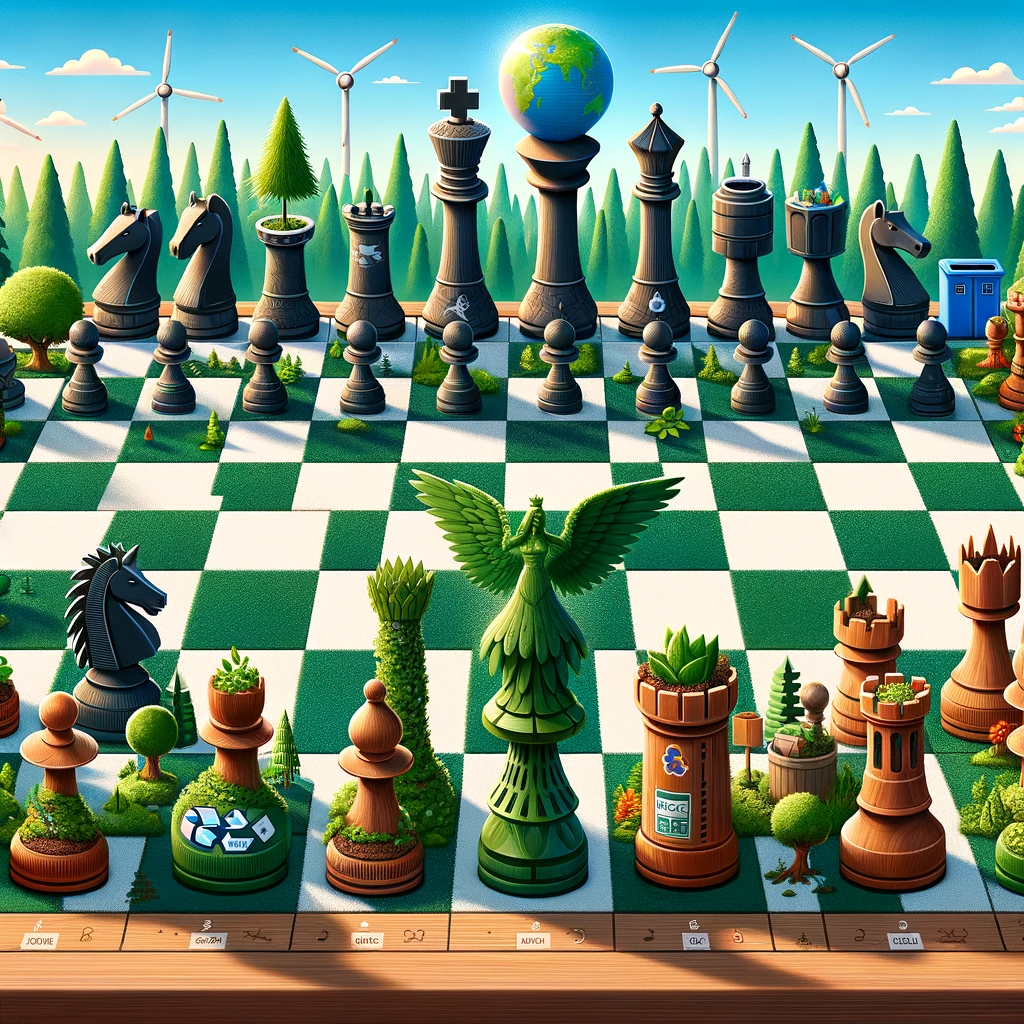
Welcome to Eco Chess, the game where every move determines the future of our planet. Unlike traditional chess, where the goal is to checkmate your opponent, in Eco Chess, each player’s objective is to make strategic decisions that benefit Earth’s health and sustainability. Let’s dive into the rules of this crucial game.
The ‘Rules’ of Eco Chess:
1. Every Move Counts: Each daily action, whether choosing a reusable coffee cup or taking public transport, impacts our environment. These are your moves on the Eco Chessboard.
2. The Pieces Represent Actions:
– Pawns: Small daily decisions (e.g., recycling, using energy-efficient bulbs). Small decisions stack up.
– Knights: Advocacy and activism (e.g., participating in environmental campaigns).
– Bishops: Investing in sustainable technologies (e.g., solar panels).
– Rooks: Significant lifestyle changes (e.g., moving towards a more organic, plant-based diet). This change recognises 1) the continuing requirement of “developing” countries for animal protein, for both nutritional and cultural reasons, and 2) the need to minimise the adverse effects on biodiversity of growing crops (plant protein) using systems that rely on the routine use of pesticides and herbicides.
– Queen: Your voice and influence (e.g., educating others about sustainability).
– King: The planet, the piece we are all striving to protect.
3. The Objective: The goal is a sustainable, balanced board where the King (our planet) is not in danger.
4. Scoring System:
– +1 point for small sustainable actions (Pawns).
– +5 points for larger lifestyle changes (Rooks).
– +3 points for advocacy and community engagement (Knights).
– Bonus points for innovative sustainable solutions (Bishops).
– Points lost for unsustainable choices.
5. Collective Gameplay: Success in Eco Chess requires collaboration and collective action.
6. Adapt and Innovate: Be ready to adapt your strategies to new environmental information and challenges.
Strategies for Winning:
– Reduce, Reuse, Recycle: Minimise waste and maximise resource efficiency.
– Green Your Commute: Opt for public transport, cycling, or walking.
– Support Renewable Energy: Transition to green energy sources where possible.
– Conserve Water: Implement water-saving measures at home and work.
Challenges and Obstacles:
Address common hurdles like convenience, cost, and misinformation, and offer ways to overcome them.
Real-World Examples:
Showcase how daily choices, from shopping habits to energy use, are strategic moves in Eco Chess.
Conclusion:
Eco Chess is more than a game; it’s a commitment to our planet. Each move you make shapes the future of our Earth. It’s time to think strategically, act collectively, and play to win for the sake of our planet.

