

By Graham Wellstead.
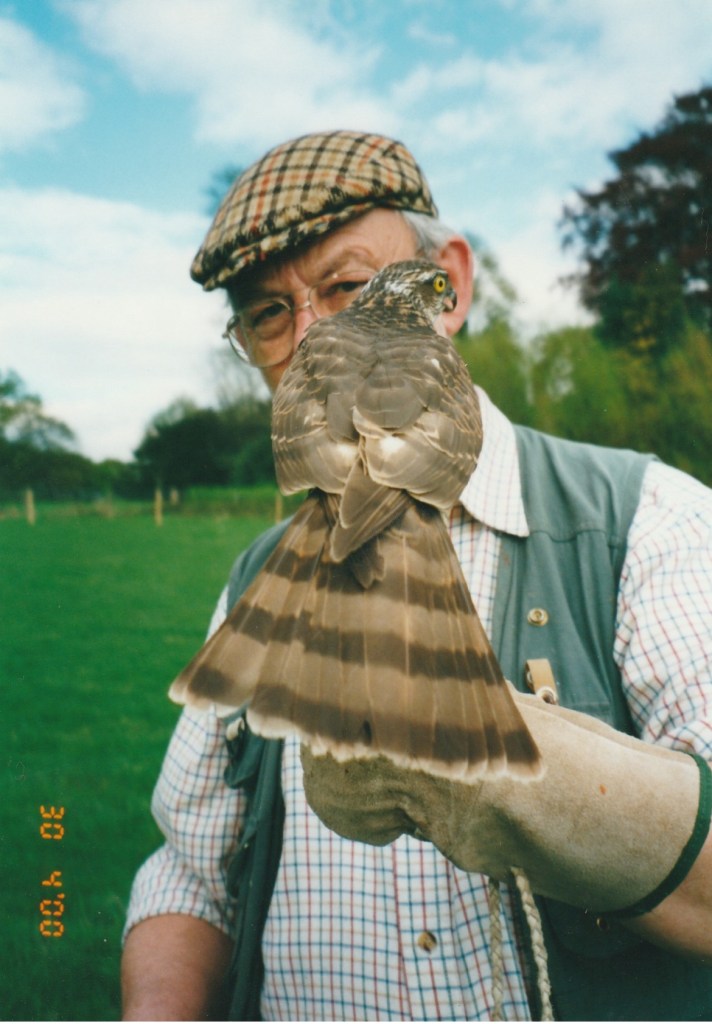
Introduction: Join us as our guest contributor, Graham Wellstead, shares a captivating journey through a life enriched by encounters with nature. From early birdkeeping to close interactions with diverse wildlife, this narrative offers unique and personal insights into the complex relationships between humans and nature’s predators. Get ready to explore a world where every creature has a story, told through decades of personal experiences and observations.
I have kept many creatures; birds and mammals mostly. I was never one for the cold blooded, apart from a pond full of ornamental fish. Reptiles don’t do much for me, I much prefer something that clearly responds. My bird keeping life began 76 years ago, when at the age of ten I began to fill the cages and aviaries my father had built for budgerigars, and then suddenly sold the lot.
In addition to pet shop canaries, plus British, African and Australian finches, over the next ten years I kept an astonishing number of birds. This was the time when birds were available from the Far East and South America and Africa, and I had many soft bills and nectar feeders no longer seen in the UK. It was an exciting time to keep birds. In addition to this, I also became a rescuer of injured wildlife, mostly, but not always, garden birds. At that time wildlife rescue was down to individuals none of whom I knew. By the age of 12, I had handled many and saved some, including the birds of prey and owls which became my main focus. Raptors were quite thin on the ground in my part of the country, basically Sparrowhawks, Kestrels and three species of owls, Little, Barn and Tawny. Now we have Buzzards, Peregrines, Hobbys, Merlin and Red Kite.
My first contact with any of these was a tawny owl obviously very tame, brought to our door simply because we were known to keep birds. The dilemma for the finder in finding someone who could help, solved. It turned out to be the pet of our local RSPCA Inspector. The owl lived on top of his kitchen door during the day and was allowed to fly off at night to catch his own food. Luckily, I knew this and quickly returned the bird. This established a rapport and we worked and learned together for the next ten years, saving many creatures
In addition to the birds I also took in mammals. My first an injured female stoat which had lost a leg. I was already involved with ferrets, poaching rabbits with some very doubtful friends. At the time a tame ferret was considered useless, and one had to take care when handling them, but Madam Stoat made the ferrets look like pussy cats. The only way I could deal with her was to shove her head in an empty tin and then wrap her up. Clearly, she could not be released, and as the wound was still open, I cleaned and bandaged the stump, put her into a rabbit hutch and hoped. Three days later she was clearly on the mend and I set about making and enclosure for her where I could shut her in the sleeping quarters when cleaning out. This was just after New Year, and resorting to the local library, and sending a question to the BBC Radio nature programme, I enquired about the behaviour and anything known, which would improve her life. I discovered she was likely to be pregnant as stoats mated in the autumn and there was a delayed implantation which resulted in the kits being born in the Spring.
Sure enough she produced a litter of six, and anxious not to disturb her, as it as possible that any interference would result in her killing her young, a phenomenon well known with ferrets. I took one at 3 weeks old and hand reared it. The strength of the milk and fat ratio being an unknown quantity. Many years later, rearing a little of eight ferrets from 3 days old, I asked the question of the people manufacturing substitute milk formula for puppies and kitten. Their response was “Don’t know – we haven’t found a milking stool low enough to milk a ferret”. Thanks – Great help!
At the time our milk was delivered from the local dairy farm and was Gold Top with one third of the pint being cream, so that was what I used, and my baby stoat thrived, so too did its siblings and albeit their mother was minus a leg she was still whizzed around as though rocket propelled. In late summer I released her and her brood in an area where rabbit numbers were eye watering.
To my intense surprise she was followed by her smaller cousin – a weasel. Now I could compare the two animals. There is an old saying: How do you tell which is which. Answer “A weasel is weasely distinguished, as a stoat is stoataly different”. Having failed to resist that I should say a stoat is basically half the size of a ferret and has a tail which ends in a black tip. In cold climes, the winter coat turns white but retains the black tipped tail, as seen on the ermine robes used on State occasions. The weasel is much smaller and lacks the black tipped tail. It is said “A weasel may pass through a wedding ring” and although I have never tried to prove it, they will pass through one inch aviary wire with ease.
This time instead of a pregnant mother, I was handed a tiny baby found in the middle of a country road, and happily, the finder recognised the tiny creature for what it was. I was now able to directly compare the two species. If I had thought the now fully grown female was quick, I was soon to discover that by comparison, the weasel made the stoat look slow. We had a 5-seat couch and she would burrow behind the cushions at one end to re-appear at the other, then go back and forth. It looked as though there were two, as the appearance at either end was virtually simultaneous. I have kept many animals, but for downright exuberance and fun these two were unbeatable. However, if there is any animal which is more destructive if I gets into an aviary of bird room, I have yet to meet it. I have seen the results of attacks by both. A weasel in a bird room filled with cages of budgies, decimated the stock, knocking off the tube drinkers and getting into the otherwise secure cages through the hole in the cage front. Small aviary birds, canaries, finches, even pigeons have no defence, chased to exhaustion. Fortunately, such attacks are rare, especially in urban areas, but they can and do happen. Stoats, weasels and ferrets are all members of the same family – the Mustelidae a wide ranging group, which includes badgers and otters. I have seen the results of both stoat and weasel on caged birds, but never ferrets, badger or otters. However, we do have to consider the larger and more widespread predators. And it is the larger creatures which do the most damage, and generally produces a jaundiced view of the species.
According to the RSPB, domestic cats are responsible for killing upwards of 170 million animals in the UK. World-wide the figures are staggering, and their call is – now is the time to curtail the ‘right to roam’; they have a point. I know people who would cull every domestic cat, so verment is their hatred, and people who are quite oblivious of the damage their cat (s) do.
Until very recently there were no cats living close to me except our own. At one point we had three cats and two dogs. Only one of our cats ever killed a bird to my knowledge. In this case our very posh Persian caught and killed the only siskin ever to come to my bird feeders – I was not pleased. I was able to put my hawks out on the lawn in complete safety, until a cat appeared out of the blue, killed a male sparrowhawk, dragged him free of the perch he was tethered to and abandoned the corpse in my neighbour’s garden. Now I have three or four cats which appear at intervals. My neighbour has a pedigree British Blue, but a water pistol soon put him off. He only has to see me and he is gone. He will walk along the top of the fence but doesn’t come in. Although I suspect the sight of a small falcon out on the lawn would be too much to resist. I did manage to throw a whole bucket of water over one cat which was trying his luck I scored a direct hit; he was properly soaked and never came back.
Water is certainly a deterrent to cats; they get the message without being harmed. And my personal mantra is “Do no harm!” My father had his own way, and I never knew how it worked. Our aviary complex was four or five enclosed aviaries like large open fronted box cages with interconnecting doors, at the end was 18ft long, all wire aviary. He set up a layer of ½” wire mesh on insulators, clear of the aviary’s wire roof, with a further layer of 3” wire, and connected it to the mains electricity. He sat and waited for a particular cat who regularly chased his birds to exhaustion. The cat arrived and when it was carefully trying to walk over the double wire, he threw the switch, and the cat took off. Screaming and trying to run. This attracted our dogs which chased it out of the garden and through the adjoining woodland. How he set it up I have no idea, for you would expect it to short out and blow a fuse, but it didn’t.
I later modified this with an electrified tape fence powered by a battery, as used for horses and cattle run round the fence behind my birdrooms. And later barbed wire to deter human thieves. Cats come and at all hours of the day and night, and one may have a regular routine, while others may appear randomly. Thus making control difficult. Deterrents such as sprays or high pitch sound emitters only work for a short time, spraying often defeated by rain, and once the intruder realises there is no harm afoot, sound is ignored.
Without doubt there are two creatures which are the top of the list of garden predators. The fox and the rat. Until recently (the last 20 years) foxes were never a problem for me. I did not encourage them but was quite ambivalent about them I had kept chickens and ducks which were never visited by a fox, although I both saw and heard them. Suddenly and unexpectedly, a fox killed all my chickens, which were kept in what I believed was predator proof quarters. From then on said fox tried to enter my bird aviaries. I tried scent and sound deterrents all quickly ignored and the fox visiting nightly. I had to resolve the situation as it was only a question of time before it managed to gain entry as damage was increasing.
I borrowed a fox trap. A heavy 6ftlong 2ft square wire cage. I baited and set the trap, Next morning I found the bait had gone, the trapdoor still open, for the fox had dug a tunnel under the length of the trap and pulled the bait through the wire. I never understood why it didn’t dig in from the side. At the time although I found it exasperating, as a wildlife rescuer, I placed a board under the trap to stop him digging up my lawn and next night he was caught. I was not inclined to kill him, so bundled him into a sack I took him out into the countryside and released him on the heather heathland which was army ranges.
But my fox problems had only just begun. Two falcons and a tawny owl were killed in the middle of the day. Both falcons, a male peregrine and a lanner falcon, were put out of the lawn, tethered to their block perches. This was a daily routine when they were being flown. The owl was in an open fronted shelter recovering from hitting a window..
I still have several birds of prey flown as falconry birds, but they only spend time weathering on the lawn if I am here. Either at my desk working, or busy within earshot, for if fox or cat appears their alarm call produce an instant response.
I now come to the most prevalent of our predators. The brown rat. There is an expression I have often heard, which is not far from the truth. “You are never more than six feet from a rat”. Rats are attracted by food, and food dropped under bird tables and from hanging nut and suet feeders acts as a magnet. Bird seed inevitably dropped on a bird room floor and then carried outside on your shoes, plus the birds themselves. Because I had suffered two major thefts on my canaries but human predators, I moved all my best birds to a 8ft square aviary with only the front wired, in an attempt to hide them. The night before I was due to move them back to the breeding room rats found a way in and killed and took away 24 of 27 birds, and it took me 19 days to find how they did it. Initially I thought they were stolen but the padlocks were undamaged as was the fabric of the aviary.
It is legal to poison rats and if you do it must be done with the safety of other creatures and wildlife taken into consideration. Its not difficult a sachet of rat poison in a tunnel made of wood, plastic or house bricks, keeps small birds and cats safe. But if you have something which is there all the time you must keep up the routine. Many years ago an acquaintance hunted rats in a battery chicken farm and caught 3 tons of rats a year using terriers. He once told me that for every rat you see, there at least 8 more below ground.


One response to “A PERSONAL VIEW ON PREDATORS”
Yes, well done! More to come from Graham soon…
LikeLike