
Memories of the Camberley Natural History Society
By John E Cooper
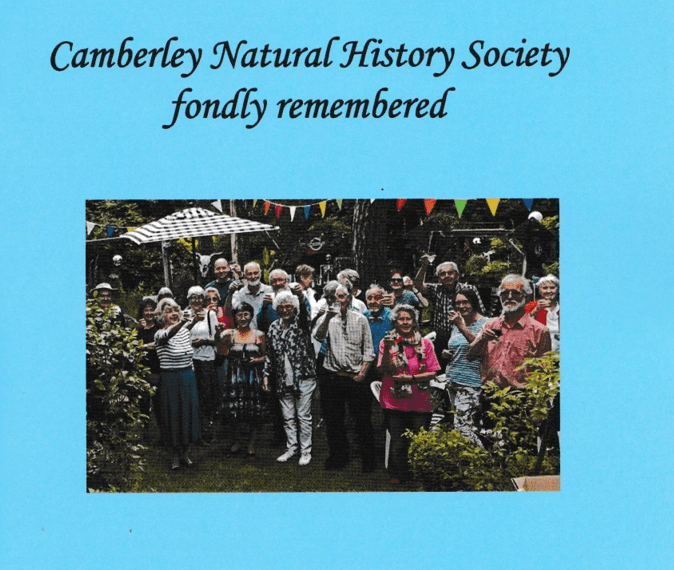
It was on 1st December 2022, in a message from Dr Pat Morris, that my wife Margaret and I learned with sadness that there was to be an Extraordinary General Meeting (EGM) of the Camberley Natural History Society (CNHS) on 16th January 2023. The purpose of the EGM, we were told, was to close down the society and to dispose of its assets.
It was in 1959, sixty-four years ago, when I was fifteen years of age, that I first attended a meeting of the CNHS at the invitation of its Founder and President, Major Maxwell Knight OBE, FLS.
Earlier that year (1959), my family had left Essex and moved to Crowthorne, Berkshire, only a few miles away from Camberley. Encouraged by my parents, Eric and Dorothy Cooper (later the founders of the Crowthorne Natural History Group), I had written with some trepidation to Maxwell Knight, introducing myself and explaining that I was a keen amateur naturalist. To my surprise and delight, he replied promptly with a handwritten postcard – one must remember that there were no emails in those days, nor mobile ‘phones, and only a proportion of the public owned and regularly used a “landline”. In his message Major Knight suggested that I should cycle over for tea with him and his wife, Mrs Susan Knight.
I greatly enjoyed that first visit and recorded it at the time in my natural history diary – see later.
Over tea, I was told about the Camberley Natural History Society and invited to the next CNHS meeting as Major Knight’s guest.
That was the beginning of several years of a close relationship with the Knights and with the Camberley Natural History Society. I was proud of both associations.
Maxwell Knight was a familiar name to me and thousands of others who heard him regularly on the radio in the 1950s on such programmes as “Nature Parliament”. For years I had borrowed from the local public library books that Maxwell Knight had written. I was inspired by them and I applied what he taught in their pages to my natural history and animal-keeping activities.
Maxwell Knight became my mentor and advisor and I was greatly influenced by him. I set up my own “Bug Room” for live and dead species at my parents’ home and modelled it on his in Camberley. I joined him and others on field trips organised by the CNHS and I learned how to study animals’ tracks, signs and sounds and identify fungi, mosses and liverworts.
The Knights and their friends – fellow members of the CNHS – especially Mr and Mrs Tucker, who ran a wildlife rescue centre, guided me on the care of various animals that I found or had brought to me. One of these became something of a celebrity. On the 5th May 1960 Major Knight gave a talk to the Camberley Natural History Society on “The Senses of Animals” and, knowing that I was nursing an injured kestrel, asked me if I would take the bird along to the meeting so that he could demonstrate its powers of sight. During Major Knight’s talk, the kestrel stood contentedly on my hand. After his talk Major Knight asked me to say a few words about how I was tending and feeding it. Afterwards I was inundated by members who wanted to see the bird at close quarters. One of these was Mr Paul Jacklin who was an experienced falconer. He subsequently became a close family friend and taught me a lot about birds of prey and falconry and later greatly encouraged me in my studies on the health and diseases of hawks.
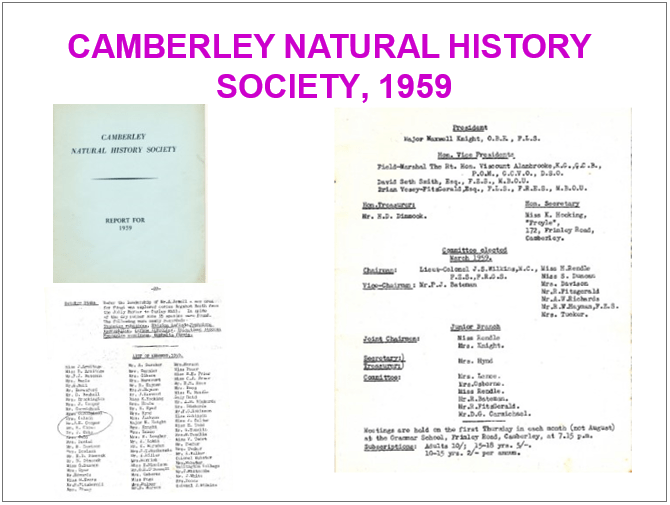
The CNHS members were a wonderfully eclectic group, ranging from local naturalists, teachers and foresters to a few academics and several retired military officers. Names of members can be seen on the scanned documents below (Figure 1). The Committee included Miss Kathleen Hocking (Hon Secretary), Colonel J S Wilkins, Mr Peter Bateman and Miss Hilda Rendle. Amongst the membership were many accomplished field naturalists, from whom I learnt a lot. They were all supportive of my ambition to train as a veterinary surgeon and few were surprised when that career path took me to East Africa and working with wildlife.
Figure 1.
I remained a member of the CNHS for many years, including my time in Tanzania (1966-67). I contributed bird, insect and herpetological records for the Annual Report. I gave lectures and I led field meetings, especially to Broadmoor Bottom and Owlsmoor.
I first started keeping a natural history diary on 3rd September 1955 when, as a (Boy) Scout, I was required to write an account for three months of birds, butterflies, trees and other natural history items that I had seen in order to take my “Woodcraftsman Badge”. I gained the badge, but decided to continue writing the diary and have now (2023) been doing so for 68 years. It gives me pleasure to look back and see what I wrote in the 1950s and 60s about the Camberley Natural History Society and all that I learnt from being one of its active members.
I could write much more but should like to conclude this short account by paying tribute to CNHS members who encouraged and guided me, amongst many others, in the past and helped promote natural history and conservation in the Camberley area and further afield. Worthy successors to those early pioneers were the more recent stalwarts who kept the Society alive and flourishing at a time when formal membership of amateur groups was beginning to show signs of decline. In particular, we all owe a debt of gratitude to Drs Pat and Mary Morris, Mr Bernard Baverstock and Ms Joan Morrad.
More information about the Camberley Natural History Society is to be found not only in my diaries and correspondence but also on the Maxwell Knight “Frightened Face of Nature (FFON)” website (established by our friend Mr Simon King and described as” WRITTEN BY NATURE DETECTIVES. Inspired by the lost manuscript of the real-life ‘M’):
Welcome to FFON. Unveiling Nature’s Challenges, Inspiring Conservation’s Future.
I am grateful to my wife, Margaret Cooper, for not only reading and commenting on this short account but for her support for my natural history interests for well over a half a century. Margaret met Maxwell Knight, she knew Susie Knight for some years and, in 1972, she willingly agreed that our second child, born in Kenya, should be named Maxwell. Margaret and I gave a joint lecture to the CNHS on Thursday 5th April 2018, entitled “Gorillas in the midst of war: health studies on one of our closest relatives”. The next day Bernard Baverstock took us round Camberley, Frimley, Crowthorne and Broadmoor Estate and we were able to see for ourselves the many changes that have taken place over recent years. Nevertheless, for me in particular, the trip provided poignant memories of my happy days as a youngster, of my mentor Maxwell Knight and of the wonderful legacy of the Camberley Natural History Society.
JOHN E COOPER, DTVM, FRCPath, FRSB, Hon FFFLM, FRCVS
RCVS Specialist in Veterinary Pathology
Diplomate, European College of Veterinary Pathologists
Diplomate, European College of Zoological Medicine
……………………………………………………………………..


3 responses to “The Camberley Natural History Society (CNHS)”
Thanks for a great story and sad to hear the CNHS has finally closed. Wonderful memories of very different times past. Shame to scanned documents has not reproduced.well. Rob Downing.
LikeLike
Hi John, very good but sad story too.
I’d really like to see your diaries and hear any stories you have. Please email me if that’s possible. dolandscapes37@gmail.com
thanks
David
LikeLike
[…] was a member of Camberley Natural History Society which Maxwell Knight founded. I was sad to see (here) that the society became defunct in 2023. At the time of writing those articles in 2014 and 2019 I […]
LikeLike