
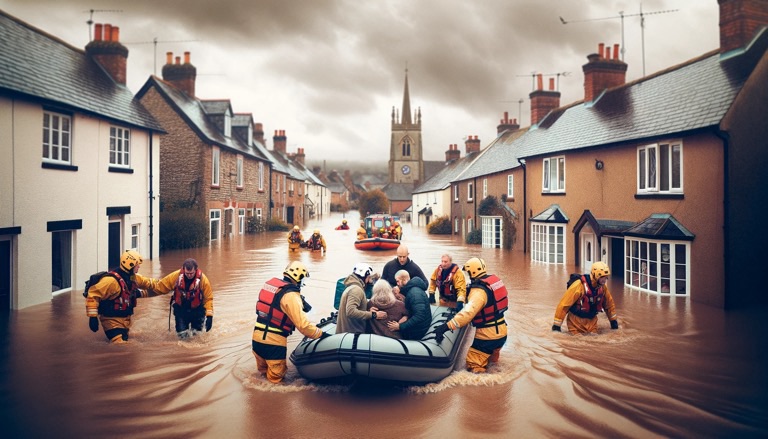
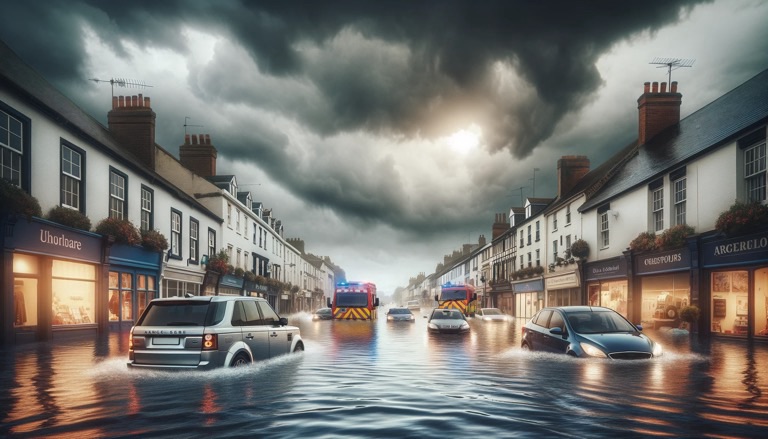
As the UK reels under the impact of Storm Henk, the first named storm of 2024, communities across the nation confront unprecedented flooding challenges. Following a series of winter storms, including Storm Gerrit in late December 2023, the UK’s landscapes were already saturated, setting the stage for Henk’s devastating effects.
The heavy rainfall began in earnest on January 2, 2024, with England and Wales recording over 40 mm of rain in just 24 hours. The consequent rise in river levels led the Environment Agency to issue more than 250 flood warnings across England. In response to the rapidly escalating situation, British Prime Minister Rishi Sunak assured the public of the Environment Agency’s prompt action, deploying hundreds of high-volume pumps and personnel to the affected regions.
The Midlands and parts of southern England were significantly inundated, with notable incidents like the flooding of an area around 10 acres in East London following a canal breach in Hackney Wick. In Nottinghamshire, the surging River Trent prompted the declaration of a major incident, with evacuations ensuing at Radcliffe Residential Park. Even the historical Alney Island in Gloucestershire wasn’t spared, as residents were urged to evacuate overnight.
The physical toll of the storm has been palpable, with strong winds causing widespread damage and power outages affecting over 107,000 homes at the storm’s peak. Beyond the tangible damage, the emotional and psychological impact on those affected is immeasurable.
As the UK contends with these relentless weather patterns, the question arises: Are we witnessing the new norm due to climate change? The repeated instances of severe weather underscore the urgency for enhanced flood defences and sustainable urban planning to mitigate such disasters’ impact in the future.
Storm Henk serves as a stark reminder of nature’s unpredictable power and the need for resilient communities in the face of climatic adversities. As the UK recovers and rebuilds, this event may well be a pivotal moment in shaping the nation’s environmental and infrastructural policies.


2 responses to “Storm Henk Unleashes Havoc: A Closer Look at the UK’s Battle with Flooding”
“Due to climate change?” I am glad you asked this question, Simon. Natural climate change is self evident and nothing new. Many of the floods like those we have witness recently are nothing new. See my WordPress blog example covering the history of flooding in a South Yorkshire village over hundreds of years.
The current fashion for naming every new storm and giving out alarming weather warnings seeks to engender fear and anxiety in the population giving a false, even deliberate, impressions to the public.
Unusual weather events world wide in recent times, such as raging fires, devastating floods, hurricanes, earth quakes etc must be seen, as evidenced by a growing body of investigators, to be due to geo engineering, these covertly and therefore without our permission. Undertaken by governments and state actors to manipulate the weather for nefarious reasons. Such examples include chemical spraying the skies seeding clouds to promote rainfall and sun blocking. These can be clearly seen in the skies on looking up on a weekly basis. Directed energy weapons (DEW) such as those used in Maui. Deliberate fire setting in conjunction with purposely mis managed countryside. See two documentaries about this below.
The above is part of a deliberate and illegal weather warfare to create fear, control, financial profiteering and population manipulation in an anti human dystopia. These manufactured events help to give the impression that we are facing a climate crisis, which we are not. Blame it on human action is part of the clearly documented agenda 2020/30 lead by the UN and WEF who both fund agencies and the media to promote this fallacy. Rob
LikeLike
Hello, Rob
Thank you for sharing your views and for pointing us towards your blog. We value the time you’ve dedicated to researching the historical flooding in South Yorkshire. Having a variety of perspectives and historical insights is indeed invaluable.
Regarding the naming of storms and issuing weather warnings, these practices aim to raise awareness and ensure public safety. While it’s true that unusual weather events have been part of our history, the scientific consensus supports the view that the frequency and intensity of such events are escalating due to climate change. This stance is backed by extensive research, including reports from reputable bodies like the Intergovernmental Panel on Climate Change (IPCC).
Concerning the theories of geoengineering and others you mentioned, we acknowledge the breadth of viewpoints on these issues. However, our blog focuses on peer-reviewed scientific research and the consensus within the scientific community. We believe it’s crucial to distinguish between well-supported scientific findings and other theories that might not have the same level of empirical support.
In mentioning climate change in relation to Storm Henk, we base our approach on the understanding that climate change is exacerbating the severity and frequency of weather events, as supported by current scientific knowledge. Our goal is to provide our readers with information that is not only engaging but also grounded in the latest research and environmental science.
At FFON, our greatest concern remains the rate and speed of climate change and how nature is struggling to adjust to these rapid changes. Our commitment is to foster open dialogue and to provide insights that help in understanding these complex issues. We appreciate your contribution to the conversation and welcome ongoing discussions that enable us to share knowledge and perspectives.
Warm regards,
Simon
LikeLike